

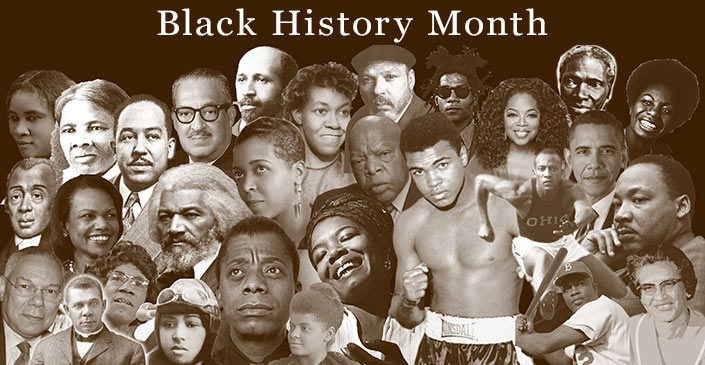
Black History Month is a time to recognize and celebrate the many achievements, contributions, and resilience of Black individuals throughout history. This month provides us with the chance to acknowledge the numerous individuals whose impact has shaped society, science, education, culture, and civil rights. By educating ourselves on these figures and their stories, we can continue to remind ourselves of the importance of equality, perseverance, and justice in our society today.
Martin Luther King Jr.
Black History Month allows us to honor those whose courage and sacrifice allowed reforms and change to take place for the better—not only for the Black community but for the United States as a whole. Arguably one of the most notable and praised figures is Martin Luther King Jr., whose efforts in the Civil Rights Movement heavily assisted in ending segregation and advancing voting rights. In an era full of violence and hatred towards African Americans, MLK took inspiration from Mahatma Gandhi and led powerful peaceful protests, such as the Birmingham Campaign and the Montgomery Bus Boycott. Through his motivational speeches, such as his famous “I Have a Dream” speech, he was undoubtedly able to prove that meaningful change can be achieved through peace and unity. Martin Luther King Jr.’s legacy continues to be honored today, with the third Monday of January being designated as a national federal holiday in remembrance of his great works and achievements. Even after his untimely death, he continues to inspire and empower movements for justice and equality to this very day.
Rosa Parks
Another powerful figure is Rosa Parks, who is often referred to as “the mother of the Civil Rights Movement.” In 1955, Rosa Parks courageously refused to give up her seat on the bus to a white passenger in Montgomery, Alabama. This was strictly prohibited at the time in Southern states due to unjust Jim Crow laws. Her arrest sparked uproar within the community and led to the Montgomery Bus Boycott, a 381-day protest where African Americans refused to ride city buses. This significantly impacted the city transport’s revenue, as African Americans made up the majority of the passengers. Through their resilience, the protesters were able to bring national attention to the racial injustice they faced, ultimately leading the Supreme Court to rule bus segregation unconstitutional. Parks’ quiet strength and firm stance on her beliefs represent a bravery that doesn’t always need to be loud in order to be powerful. Through her actions, she has empowered many others to stand up to discrimination and strive for a better world.
Malcolm X
Malcolm X is also regarded as an influential Civil Rights leader who advocated for Black empowerment and self-defense. Although most leaders were primarily focused on unity through nonviolence, Malcolm X stressed the importance of economic independence and the right to defend oneself from injustice. As a powerful speaker and an individual associated with the Nation of Islam, he challenged systemic racism and encouraged African Americans to reclaim their identity and demand respect. After leaving the Nation of Islam and traveling abroad, Malcolm X’s perspective changed, and he began to express the importance of global human rights and unity across races. His writings and speeches continue to educate readers on issues of human rights and the complex racial injustice faced in America; his ideas still influence activism and equality in this day and age.
Mae Jemison
Mae Jemison represents innovation and achievement in the fields of science and exploration. In 1992, Jemison made history by becoming the first Black woman to travel into space aboard the Space Shuttle Endeavour. Before she became an astronaut, she worked in the Peace Corps as a medical doctor, providing healthcare to underprivileged communities. Beyond her advancements in space, she has dedicated her time to promoting science education to the youth, especially young girls and children of color. Mae Jemison’s story not only marked a huge milestone for NASA but also broke barriers in STEM fields and inspired countless young people to pursue careers in science, medicine, engineering, and technology.
Conclusion
As we reflect on the lives of influential Black figures, it becomes evident that their perseverance and bravery continue to inspire new generations. Black History Month is not just about remembering the past and these figures’ legacies; it is also about carrying the lessons of leadership and progress into the future. By honoring these remarkable individuals and striving to create a more inclusive world, we ensure that their impact continues to live on in our communities, schools, and everyday lives.